
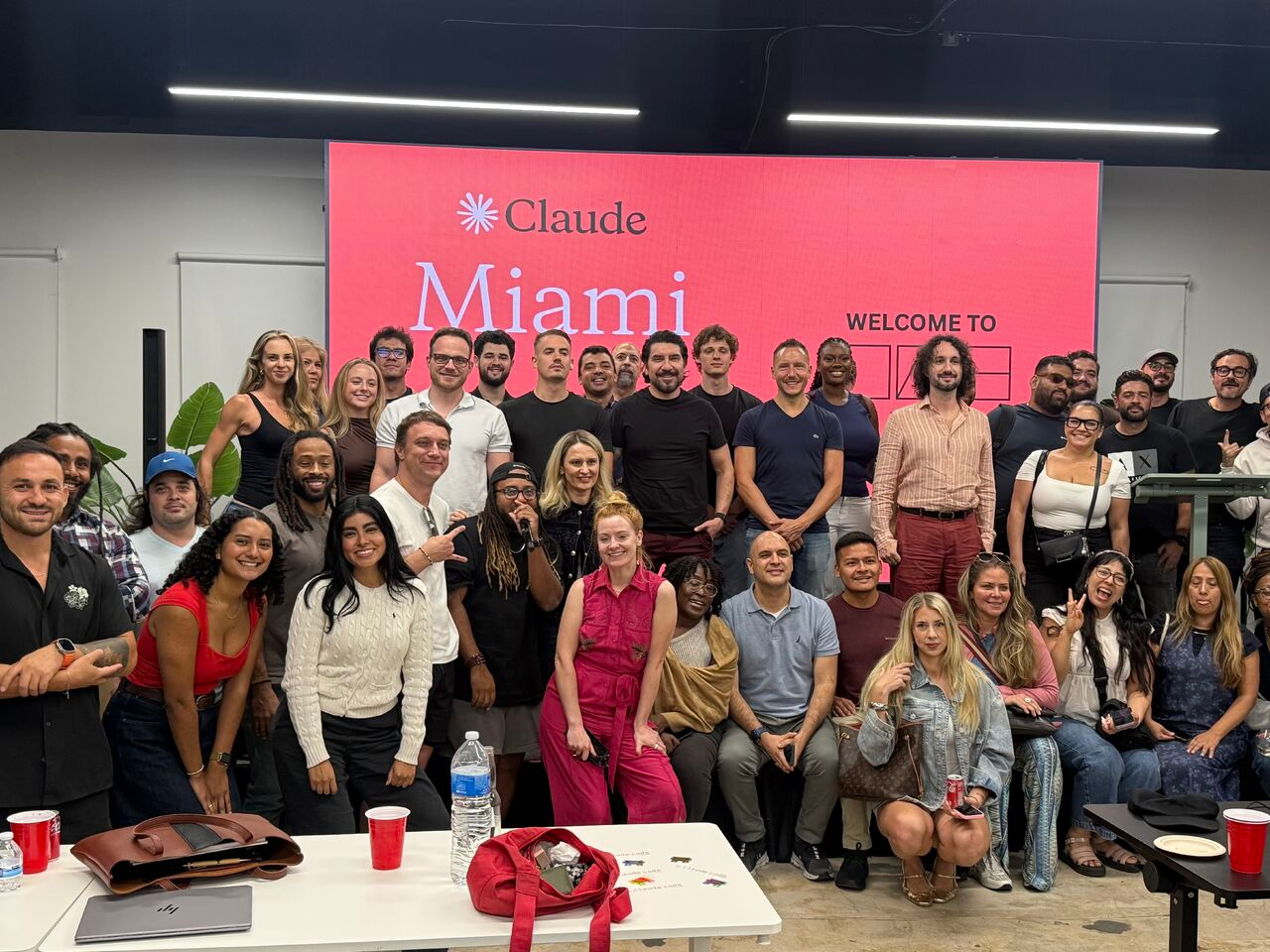
8 Findings From the AARRR 2.0 Experiment at The LAB Miami
Every founder right now is rushing to become “AI-powered.”
But speed without a system is just faster failure.
AI didn’t fix growth — it made bad architecture faster to ship.
You can generate code and launch features 10x faster. But you still cannot prompt away a broken handoff between teams, a fuzzy ICP, or a digital product that does not convert traffic into real Revenue.
That was the question Justin Elliott and I brought to the stage at The LAB Miami for Claude Code Community Miami in a live experiment:
AI vs Brain
Instead of discussing AI and Growth in theory, we stress-tested a real business — WRTH, an AI-native commerce platform for real-world assets — against AARRR 2.0 and human Growth & Revenue Architecture expertise.
WRTH Co-Founder & CTO Justin Elliott has raised $3M in investment. Several years ago, I was his mentor through Built in Miami.
The framework we tested:
Market Fit → ICP → JTBD → Acquisition → Activation → Revenue → Retention → Referral → AI & Tech → ROI
The question was not whether AI is powerful.
It was:
How far can AI go — and where does human judgment still matter?
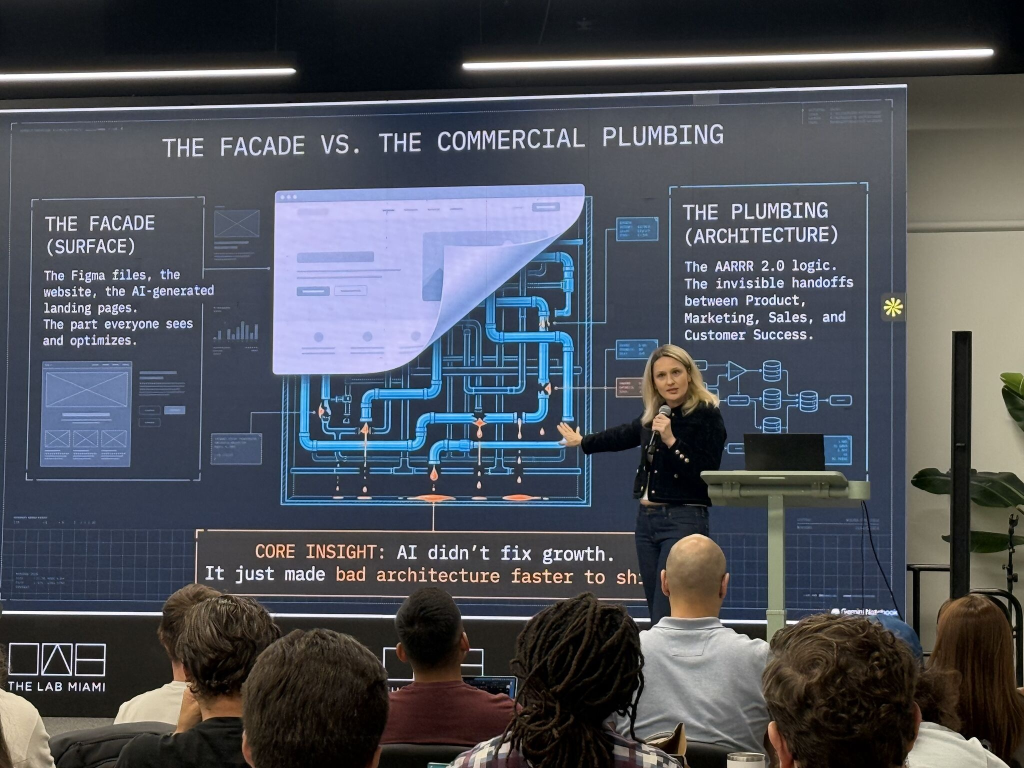
The Facade vs. The Commercial Plumbing — Revenue Architecture
The Experiment in Numbers
100+ founders, C-level executives, Product Managers, technical leaders, engineers, and AI builders joined the event.
1 real AI-native business was put through the stress test.
8 key Growth & Revenue challenges surfaced.
And the experiment led to 1 interactive AARRR 2.0 Scanner powered by Claude, designed to help founders and teams identify Growth & Revenue bottlenecks in their own businesses.
Watch the AI vs Brain Recap
Watch the highlights from the live experiment and workshop.
8 Key Challenges & Findings From the Experiment
This was not a test designed to produce a nice-looking result, and it was not a generator of generic AI advice.
At the core of the analysis is a systemic diagnostic of the connections between:
Market Fit → ICP → JTBD → Acquisition → Activation → Revenue → Retention → Referral → AI & Tech → ROI
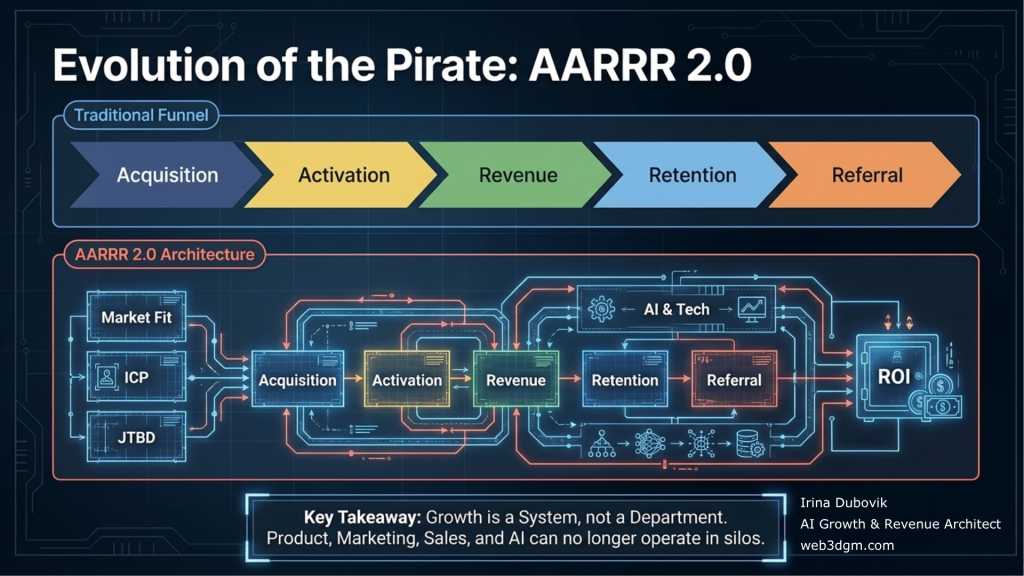
AARRR 2.0 — AI Growth & Revenue Architecture Framework
1. Market Fit, ICP and JTBD
Many founders find it difficult to clearly formulate the Job to Be Done. Many learned this formula for the first time:
Market Fit = ICP + JTBD
2. “Funnel” and “Architecture”
The words “funnel” and “architecture” are understood differently by different teams, which leads to failures.
“Funnel” is often associated with infomarketing and Instagram. Here, we are looking at the conversion funnel of the entire business.
“Architecture” here is not technical architecture. It is Growth architecture + integrations.
3. Customer Journey Map and User Story Map
The report shows the difference between a Customer Journey Map — a map of customer touchpoints and the user journey — and a User Story Map, which reflects the logic of the real Buying Journey / Happy Path with triggers and converters.
For many participants, an unexpected discovery was the gap between how they imagine the customer’s path to conversion and what is actually happening in their business.
4. AI Tools
It is possible to identify duplication of AI tools across different functions — Marketing, Sales, Product — and see how those tools are applied across the entire system, rather than only for one person or one function.
5. Lead Magnet
Almost no one is using a Lead Magnet as a mini-version of the actual product or service.
At the same time, it can deliver higher conversion.
This should not be confused with the Instagram mechanic of:
“Fill out a form and get a PDF.”
6. Digital Product Is Part of the Business
For CTOs and developers, it became clear that behind a website there needs to be Growth architecture, an AARRR 2.0 conversion funnel, and an understanding that every Digital Product is part of the business.
7. Visibility for LLMs and SEO
AI does a great job diagnosing a project’s visibility for LLMs and SEO.
There are also many cases where teams are not doing this at all — they are simply coding the product.
8. Referral
The Referral mechanism should be embedded into the User Journey, rather than existing as a separate program.
For B2B SaaS, this is a key conversion channel.
Garbage In — Garbage Out
When the input changes, the result changes.
Only the people inside the company truly know what is working, what needs to be fixed, and who owns it.
And that led to the main conclusion of the experiment:
There is no choice between AI and human expertise. We need both.
AI can be a superpower for technical diagnosis, inspection, analysis, and execution.
But the final decisions still require human expertise:
What should connect to what?
In what order?
With which converters?
Who owns the handoff?
Which metric defines success?
How does it contribute to Revenue and ROI?
From Experiment to Practical Value: AARRR 2.0 Scanner
For me, the Proof of Product / Product-Market Fit stage for AARRR 2.0 was completed through this experiment.
The next step was turning the framework into something founders and teams could apply to their own businesses.
With Claude, I built an interactive AARRR 2.0 Scanner.
It takes a founder or team through critical questions across the entire AI Growth & Revenue Architecture:
Market Fit → ICP → JTBD → Acquisition → Activation → Revenue → Retention → Referral → AI & Tech → ROI
What the Scanner gives you
Personalized Growth & Revenue Diagnostic
A targeted assessment of your metrics, funnel, handoffs, and potential bottlenecks.
PDF / HTML Report
A structured report with findings and priority areas.
Dedicated Claude Execution Prompt
A custom prompt to continue analyzing the system, stress-testing hypotheses, and refining the strategy independently with Claude.
Run the AARRR 2.0 Scanner:
https://lnkd.in/eDB6Y9ER
Best Question Award: Pablo Pupo, Founder of Accordo
Pablo won the Best Question Award at the AARRR 2.0 AI & Growth Architecture workshop — and an AARRR 2.0 Review with me.
What made the connection even more interesting is how much sits at the intersection of music, AI, and entrepreneurship.
Classical Pianist | AI Engineer | Founder, Accordo
Pablo is a classical pianist and former opera and choir singer with FGO. He has won state and national competitions, was selected as one of only four music scholarship recipients from 600+ applicants across Florida, and became the first and youngest student in UF history to reach the highest level of music theory directly.
He is also an AI Engineer with a Computer Science background at UF and Founder of Accordo, a platform connecting musicians with each other and with opportunities.
His goal is to modernize an industry that still largely runs on word of mouth — while bringing more humanity and music into the tech world.
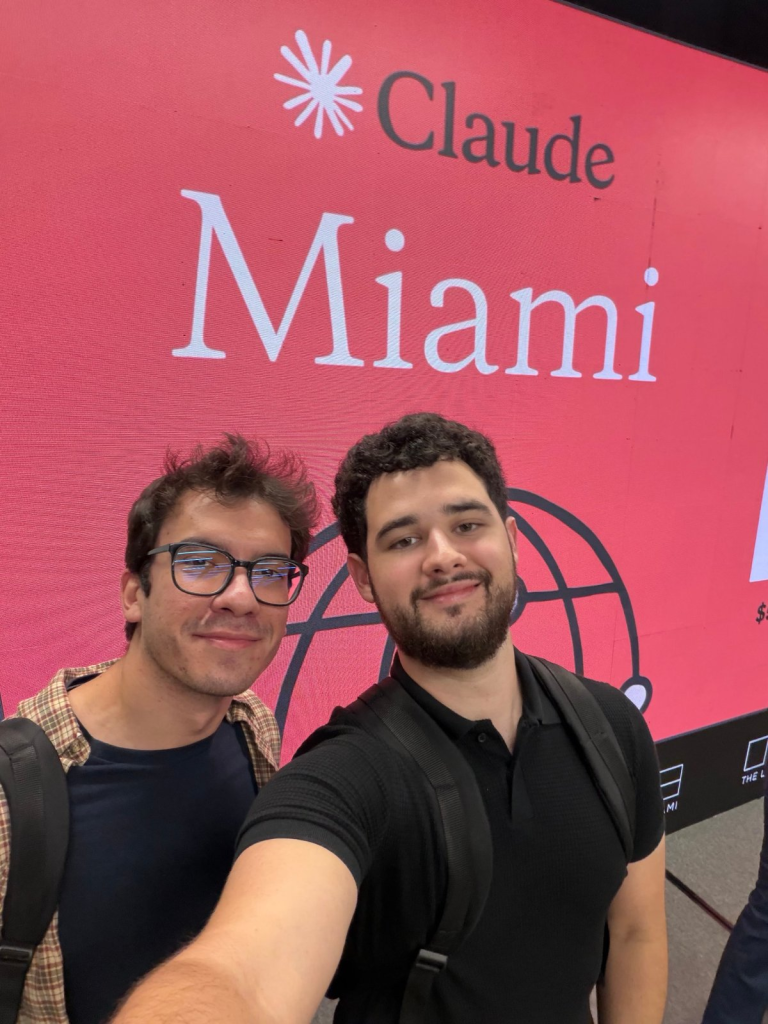
Accordo Team
“One of my biggest takeaways from the AI vs Brain workshop was that AI is most powerful when it expands what people can do, rather than replacing what makes us human.
As someone building Accordo at the intersection of technology and music, that really resonated with me. I see AI as a way to remove friction so people can spend more time creating and collaborating.
At Accordo, our goal is to use technology to make the music industry more efficient and connected without losing the human relationships that make it valuable in the first place.”
— Pablo Pupo, Founder, Accordo
Pablo’s perspective captures one of the central conclusions of the experiment: the strongest role for AI is not to remove the human layer, but to expand what people are able to create, decide, and build together.
From Miami to ROI Capital
Miami founders are raising the bar — and we’re getting closer to becoming a real ROI capital for founders.
But becoming a real Tech Hub and ROI Capital is not just about launching more startups.
It requires founders, builders, engineers, Product leaders, Growth leaders, investors, and operators connecting their expertise and helping each other turn ideas into sustainable businesses.
My dream is simple:
Behind every founder’s dream, there should also be a path to ROI.
And my next goal is bigger than one workshop or one Scanner:
I want to scale and embed AARRR 2.0 into Claude.
An AI Growth & Revenue Architecture Framework for AI-native businesses — connecting:
Market Fit → ICP → JTBD → Acquisition → Activation → Revenue → Retention → Referral → AI & Tech → ROI
What Participants Said
One of the strongest signals after the event was not simply the number of reviews.
It was who the framework resonated with.
Senior technology leaders, developers, Product Managers, AI builders, founders, operators, and sales leaders all took different ideas from the same architecture.
That cross-functional response matters because Growth does not live inside one department.
Neither does Revenue.
1. Pablo Silva
VP / Head of Global Media & Tech Operations
Applied AI, LLM, ML, Transformation & M&A
Paramount
Because Pablo’s original post is short, I would keep the key line visible in text:
“Thanks Irina Dubovik for the great talk (AARRR 2.0).”
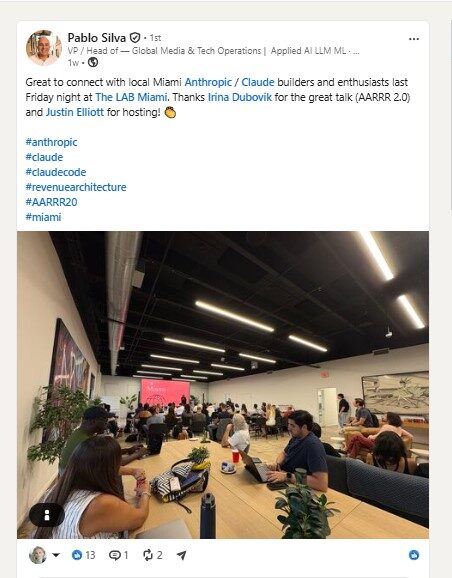
Seeing AARRR 2.0 resonate with senior technology and transformation leadership is particularly meaningful. When engineering, technology operations, Growth, and executive leadership can read the same system from their own perspectives, the framework becomes a shared cross-functional language.
2. Maria Rodriguez
Software Developer | AI Automation
Florida International University
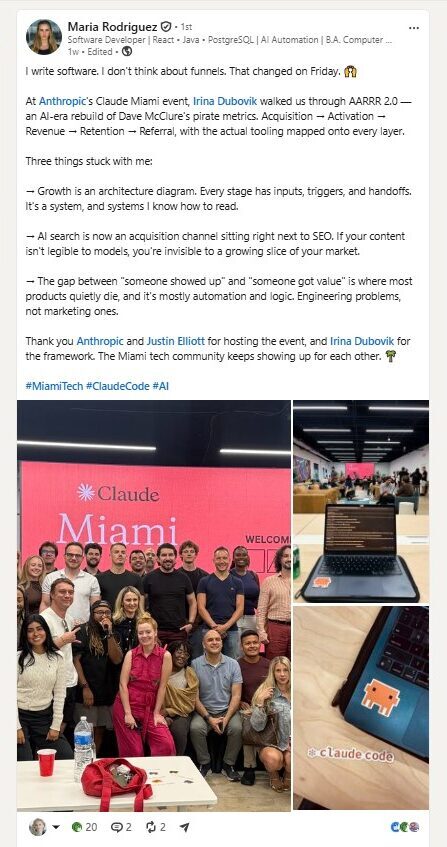
Maria’s review is strong enough visually and conceptually that I would not duplicate it in text. It shows one of the most important shifts from the workshop: a developer beginning to see a Digital Product not only as software, but as part of the Growth & Revenue system around it.
3. Bill Reque
Product Manager, Growth & CX
eCommerce | Payments | Banking
FIU Chapman Graduate School of Business
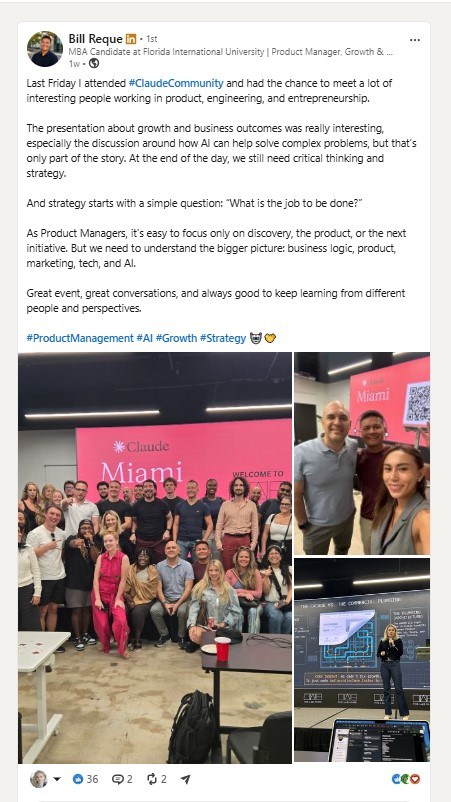
Bill’s review is also substantial enough to stand on its own in the screenshot. His takeaway connects AI, critical thinking, strategy, and JTBD — one of the core starting points of AARRR 2.0.
4. Jorge Gonzalez
Technical Lead
AI, AWS & Python
PMG
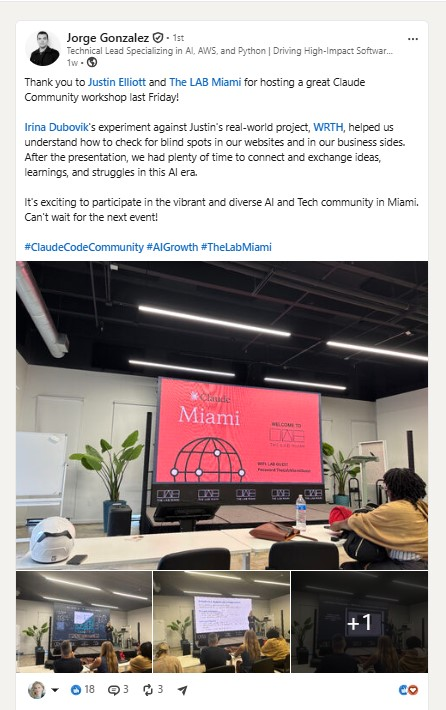
Jorge’s review is particularly useful because it comes from a technical leadership perspective and focuses on the blind spots between the website, technology, and the business side.
5. Sergei Lavrinenko
AI Product & Solutions | Ex-Founder | 0-to-1 Builder
EPAM Systems
Sergei’s post is relatively short, so I would retain one line in text:
“Was pleased to assist Irina Dubovik with her AI experiments.”
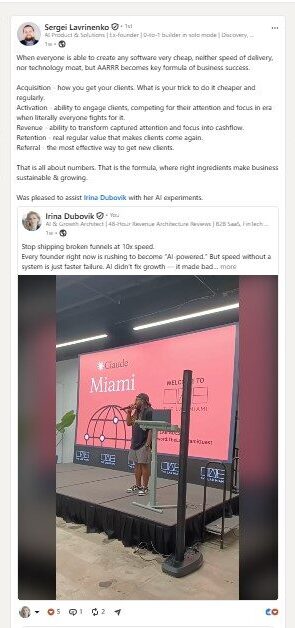
Sergei also contributed directly to the AI vs Brain experiment. His work helped surface an important technical finding that became part of the broader conclusion: AI is strong in technical diagnosis, while full Revenue Architecture still requires domain expertise, sequencing, ownership, measurement, and ROI logic.
6. Veronica Marshall
Founder | AI & Warehouse Optimization Consultant
Whynda / Lifting & Racks LLC
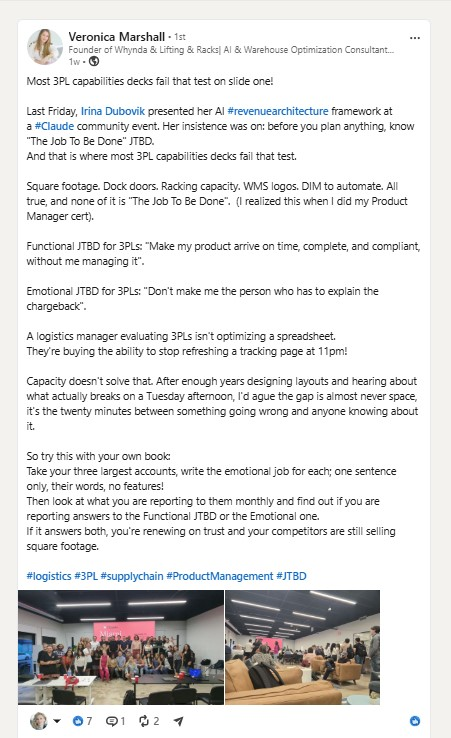
Veronica took the JTBD logic from the workshop and immediately applied it to 3PL. That matters because it demonstrates how the framework can stay consistent even when the industry, customer behavior, buying journey, and economics change.
7. Whitney Laurent
Founder & CEO
UNIVRSE.AI
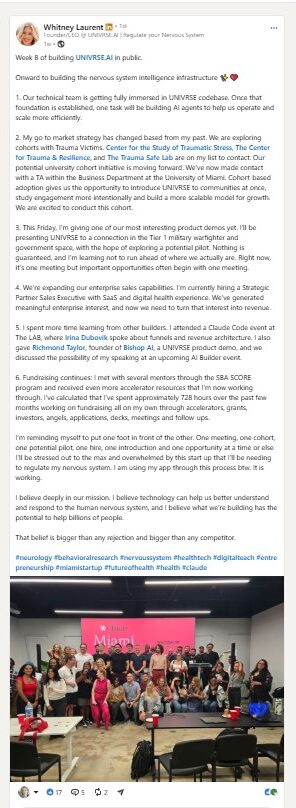
Whitney’s post sits in a different category: it shows a founder actively building, testing GTM directions, expanding enterprise conversations, fundraising, and learning from the wider Miami builder ecosystem.
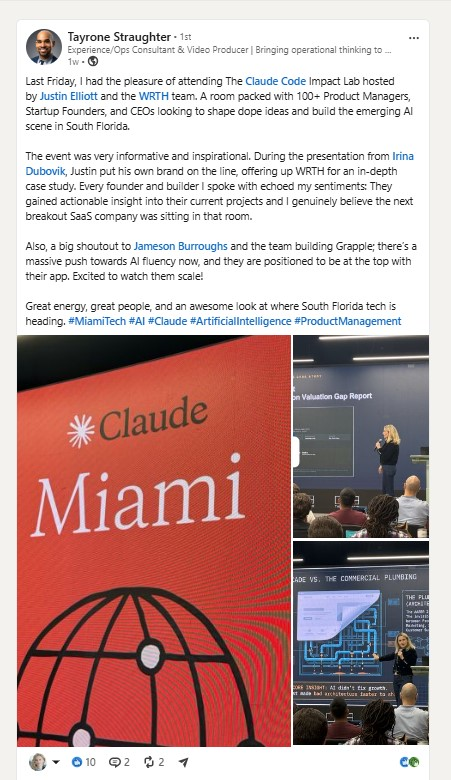
8. Tayrone Straughter
Experience/Ops Consultant & Video Producer
Hard Rock Digital
Because the core statement is powerful, I would keep just this line outside the screenshot:
“Every founder and builder I spoke with echoed my sentiments: They gained actionable insight into their current projects.”
9. Vladimir Feofilaktov
Technical Product Manager | Product Builder
Chainstack
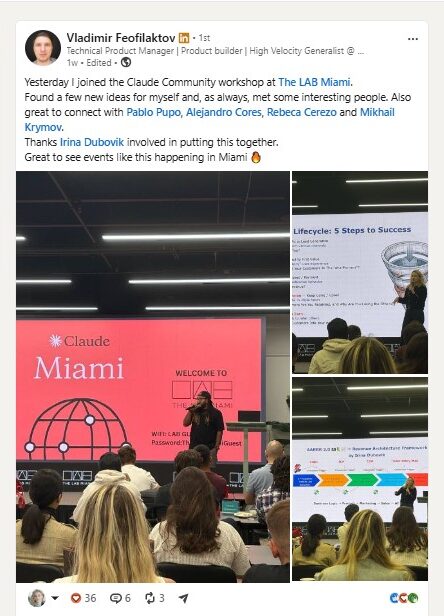
His post captures another useful outcome of the workshop: new ideas and new connections across disciplines.
10. Alain Haug
Global Sales Manager
SaaS | Enterprise Account Management | EMEA & US
System Crew GmbH

Alain’s review adds the Sales and Business Development perspective and reflects how much of the conversation continued after the session itself.
AI vs Brain? The Real Answer Is AI + Brain.
The experiment did not show that AI should replace Growth expertise.
And it did not show that humans should keep doing work AI can now perform dramatically faster.
It showed a more useful division of labor.
AI can diagnose, inspect, analyze, and execute faster.
Human expertise determines how the pieces should connect into a system that produces Revenue and ROI.
That is the opportunity.
Not to ship disconnected funnels faster.
Not to add another layer of AI tools on top of fragmented Product, Marketing, Sales, and Technology teams.
But to build AI-native companies where the customer problem, business logic, Product, Marketing, Sales, AI & Tech operate as one measurable system.
Market Fit → ICP → JTBD → Acquisition → Activation → Revenue → Retention → Referral → AI & Tech → ROI
That is where the next phase of AARRR 2.0 begins.
Thank You
Thank you to Justin Elliott for the continued support and for everything you are doing to grow the Claude community in Miami.
And thank you to WRTH, Claude Code Community Miami, Anthropic, Dave McClure, Sergei Lavrinenko, Dmitry Dubovik, and The LAB Miami — and to everyone who joined, asked questions, challenged ideas, shared insights, and continued the conversation afterwards.