
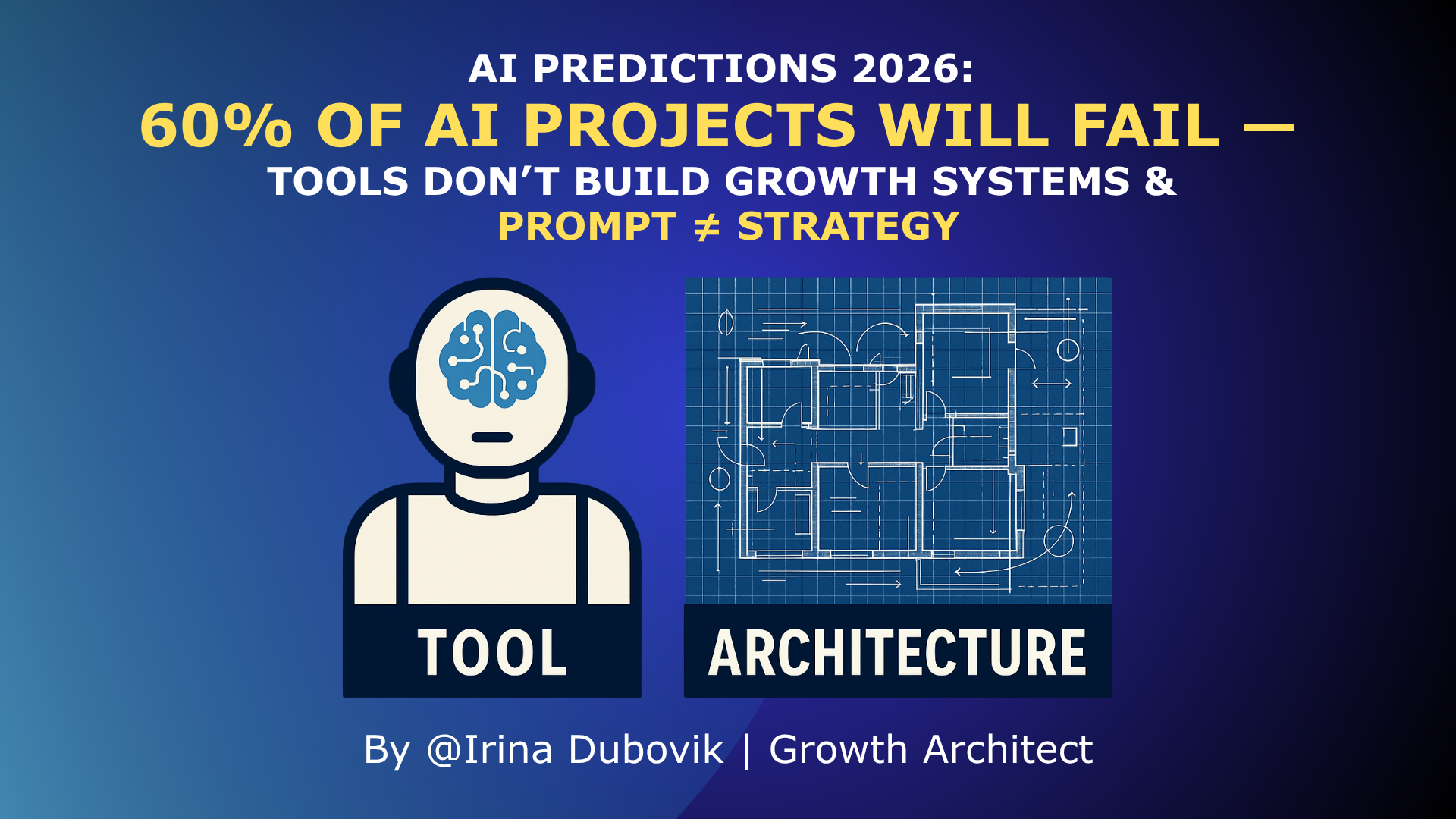
By Irina Dubovik, B2B & Startups Growth Strategist and GTM Architect.
My AI Prediction for 2026
In 2026, AI will increasingly become a core professional skill and qualification requirement. Marketing professionals and business leaders will need to combine deep domain expertise with AI literacy.
While hype around automation, infobiz experts, AI-generated content, and new tools will continue, the emerging trend will be ROI, human-in-the-loop and responsible usage approach. AI is a superpower, not a replacement for humans, and applying critical thinking and fact-checking.
I anticipate that 50–60% of AI implementation initiatives in business will fail to deliver their promised results and ROI because organizations adopt AI without integrating it into unique funnels at the intersection of Product, Marketing, and Sales, or without proper training and certification of executives and specialists. Similarly, AI practitioners who are self-taught without solid foundational education in marketing or their domain face a high risk of failure. Professionals who understand frameworks like Jobs To Be Done — knowing which tools to use for which business problems and ensuring Market Fit — will be in high demand.
Implementing AI without these core skills shifts the risks onto businesses and founders.
🧩 Agents vs Strategy: A Core Distinction
AI agents and tools automate tasks.
Growth Funnel architecture connects everything — meaning, processes (including AI, tools, and agents), and money.
Prompt ≠ strategy.
It’s tempting to build an “AI agent” and call it a product. But that’s backward.
- Many teams build an agent — then wonder why it doesn’t scale or convert.
- The better path: you architect the funnel, map the customer journey, define influence layers — then insert the agent as a tactical enhancer.
They build from the tool outward. You build from the goal inward. And that’s exactly why you win.
🧠 An AI Agent Is Not a Strategy
The world is rushing to build GPT agents — launching them into marketplaces, embedding them in websites, and calling it “innovation.”
But most AI agents today are just dressed-up chatbots:
- No brand voice.
- No funnel logic.
- No measurable ROI.
We’re confusing tools with strategy — and that confusion costs companies millions.
An Agent Is a Component, Not the System
A good agent is a tactical unit, one touchpoint in a larger growth architecture.
It belongs inside your funnel, not instead of it.
Example architecture — AI-enabled B2B funnel:
- Attract: LinkedIn content + blog → SEO & retargeting
- Engage: GPT agent offers a mini audit or resource
- Convert: AI summarizes prospect’s pain points → personalized Calendly flow
- Close: Sales call with context passed from agent
- Retain: Post-sale onboarding via automated GPT follow-up
- Refer: Trigger NPS + social-proof agent → capture testimonials
Here, the GPT agent isn’t “the strategy” — it’s a conversion layer that serves a specific purpose.
Marketplaces Are Not a Marketing Strategy
Listing your agent on ChatGPT, Gemini, or AI Agent Store may bring visibility, but visibility ≠ impact.
Real growth happens when your agent:
- plugs into the customer journey,
- reinforces your value proposition, and
- moves users forward in your funnel.
Example — Agent with contextual relevance:
A SaaS founder builds a GPT agent that routes visitors by segment:
Startups → GTM sprint case study; Scale-ups → ROI calculator; VCs → one-pager PDF.
Now the agent doesn’t just “chat” — it qualifies, routes, and warms up leads, accelerating decisions.
Don’t build for the marketplace — build for momentum.
AI Without Brand Voice = White Noise
Most AI content sounds the same.
If your agent doesn’t carry your brand’s tone, mission, and positioning, you’re not scaling — you’re automating mediocrity.
Example — Branded GPT Agent:
A fintech startup launches an agent that speaks its brand language — confident, clear, customer-first.
It answers FAQs, handles objections, and mirrors the company’s values in how it explains compliance.
That’s not noise — that’s brand presence at scale.
Strategy Beats Stunts — Every Time
You can now spin up an agent in 20 minutes, embed it inside ChatGPT, and launch to the world.
Exciting — but speed is not traction.
Real traction comes from a clear value narrative, an integrated funnel, and a strategy that compounds across channels.
Example — Agent embedded in strategy:
A growth consultant creates a public GPT that offers a 30-minute funnel review.
The agent asks key questions, provides personalized feedback, and ends with a CTA to book a $300 strategy sprint.
From curiosity to commitment in one loop — that’s architecture, not automation.
Why Funnel Architects Outperform Agent Builders
Speed doesn’t equal impact.
Most agents float in a vacuum — no journey, no positioning, no brand signal.
They answer questions but don’t convert or scale a business because they were built without architecture.
Strategic funnel architects start with systems: they map revenue leaks, define journeys, and embed AI layers only where they create momentum.
Example — Self-updating funnel with AI:
A SaaS company with high traffic but low activation mapped five stages from awareness to retention and found gaps.
After aligning website CTAs, onboarding emails, and sales logic, they added a GPT assistant to push users through the next funnel step: demo → case study → activation → upgrade.
The result: not “another agent,” but an orchestrated layer in a dynamic system.
Because in AI, only architecture scales.
⚙️ The Rise of Marketing Engineers — Architects Behind Growth Funnel Systems
Marketing Engineers are emerging as one of the most defining roles in modern growth.
They bridge the gap between acquisition, automation, and revenue — turning fragmented marketing efforts into cohesive, measurable systems.
We’re entering an era where growth no longer scales by adding headcount, but by designing workflows that think and adapt.
The best marketing teams now act more like product teams: they build, test, automate, and evolve.
A Marketing Engineer is both strategist and builder — someone who understands funnel logic, automation layers, and data flows.
They translate business goals into systems that drive predictable revenue.
To identify them:
- Look for systems thinking, not just skills.
They question every manual process and instinctively search for scalable patterns. - Observe their curiosity.
True Marketing Engineers are always prototyping — building GPT workflows, experimenting with APIs, integrating AI tools before they become mainstream. - Hire for synthesis, not specialization.
They’re fluent in both marketing strategy and technical automation — bridging worlds that used to work in silos.
This isn’t a passing trend. It’s a paradigm shift in how growth is engineered.
The future belongs to teams that treat automation as a native marketing capability — powered by human intelligence and architectural precision.
🔍 Why So Many AI Projects Fail: Common Patterns
Here are recurring failure modes I see in B2B & SaaS contexts — and how they break real businesses.
| Failure Pattern | Description | Real-world Consequence |
| No alignment before automation | Teams automate processes before teams align on language, intent, and KPI definitions | The AI becomes noise, not guidance |
| Generic AI content / voice | Auto-generated content sounds like everyone else’s | Low engagement, low credibility |
| Chatbot-as-funnel | Use an agent as a lead pipeline, without human handoff logic | Bounce rates, poor conversion |
| AI demos with shallow context | AI cannot parse nuanced pains | Low qualification, wasted calls |
| Fake personalization | Overly templated drip emails, scaled spam | Users detect inauthenticity, churn increases |
Examples:
- Suppose an AI chatbot asks basic questions and forwards leads to a sales rep, but the rep doesn’t see the context. The handoff fails.
- Or an AI writes blog posts in a bland, cookie-cutter style — it doesn’t reinforce your brand differentiator.
These aren’t minor flaws. They cripple funnels, waste budget, and erode trust.
Find more: 10 Reasons Why AI Will Never Replace Humans
🧮 What Do the Research & Industry Reports Say?
Here’s the data backing this direction:
- Over 40% of “agentic AI” projects are projected to be scrapped by 2027 due to cost overruns and unclear business value (Gartner). Reuters+2RCR Wireless News+2
- Gartner also predicts that ~30% of generative AI projects will be abandoned post–proof of concept by 2025. AI Business
- In one analysis, 85% of AI initiatives fail to deliver expected value — often due to poor data quality or absence of relevant data. Forbes+2Dynatrace+2
- Many sources cite that 70–85% of GenAI deployments fail to meet ROI targets. NTT DATA
- From startup failure data: 42% of startups fail because there was no market need — a core reminder that tools without fit don’t save you. CBInsights+2ResearchGate+2
- The AI Incident Database catalogs hundreds of real-world generative AI failures — not just technical bugs, but ethical, governance, and misuse cases. arXiv+1
Bottom line from the research: tool-first, data-poor, governance-light AI almost always fails.
🛩️How to Build AI That Works: A Framework
Here’s a distilled roadmap for doing AI right — from strategy to execution.
- Start with real business problems
What is your funnel leak? What metric are you optimizing?
Don’t build AI “because it’s cool.” - Design the architecture first
Map your funnel: awareness → engage → convert → retain → refer.
Plan where AI “touchpoints” make sense. - Ensure domain fit & voice
AI must reinforce your brand, not dilute it. It must speak your mission. - Institute human-in-the-loop and oversight
Monitor outputs, intervene, refine. Don’t treat AI as “fire and forget.” - Measure early & iterate fast
Launch lightweight pilots, validate metrics, and evolve.
Don’t scale a pump that leaks.
Train your people
AI literacy is now table stakes. Equip every user, manager, and leader.
Govern responsibly
Bias, hallucination, misuse — manage them. Use audit trails. Verify outputs.
(Refer to research on generative AI harm taxonomy for cases: arXiv+1)
🏁 Final Word: Who Wins in the AI Era
Not the fastest builder.
Not the loudest voice.
The one who architects with discipline.
AI tools will never replace strategy.
The funnel architect — the system thinker — always outperforms the tool-only builder.
That’s why it matters who you collaborate with.
Work with professionals — people and teams who build systems, not hype.
Here’s my list of pros who inspire and build real AI systems 👇
🌍 Global innovators and platforms
Web3 Digital Marketing — Explore ready-to-go Tech, AI & Digital Marketing frameworks and tools.
Ceo & Founder: Irina Dubovik
Alcosi Group — AI & fintech solutions powerhouse.
Founder: Siarhei Khaladkou
pre.dev — AI architect & product prototyping service.
Founders: Adam Elkassas & Arjun Jay Raj
Apollo.io — Precision-driven outbound and growth automation engine for business.
MindStudio.ai — No-code agent builder powering ×10 productivity.
CEO: Dmitry Shapiro, Director of Product: Luis Chavez.
Intetics — Global engineering company led by Boris Kontsevoi, President & CEO — a true visionary in global Top 100 tech innovation.
AI Clinics with Google Certification by Miami Dade College — Practical upskilling in responsible AI.
Led by Pedro A. Santos Acosta, DBA, Executive Director of Emerging Technologies, with Michael Mannino, PhD, Sheena Johns, Jose Fernandez Calvo, and Guillermo Planos.
Web Marketing Association — Led by Bill Rice, President of WebAwards, setting web and app industry standards and recognizing top-notch digital excellence.
Matt Wolfe — One of the top voices in AI education & creative application, exploring the evolving capabilities of intelligent tech.
a16z Talent x Opportunity (TxO) — Fund & accelerator empowering bold entrepreneurs driving cultural breakthroughs.
Google for Startups — Global platform supporting founders through mentorship, community & AI innovation programs.
🌴 Leaders and initiatives shaping Miami’s AI & startup landscape
· Patricia Tavira — President, AI Salon Miami & Innovapreneurs; Cofounder, MiamiTechConnect — helping enterprises harness AI.
· Grant Kurz Founder & CEO of DeepStation | OpenAI Academy Launch Partner.
· Mana Tech — Miami Immersion Program — Startup accelerator program. Etienne Gillard, Head of Ventures, Facundo Masello and the team.
· Conquista — Strategic business consultancy and expert community helping companies across the Americas grow, transform, and achieve measurable results.
Founder & CEO: Rodrigo Castro
· Connecting Giants and Unicorns — Global venture community connecting founders and investors.
Co-founders: Sabina Shuminov and Michael Burtov
· eMerge Americas — led by Melissa Medina, Co-Founder & CEO eMerge Americas + Partner, Medina Ventures and the team.
· Miami AI HUB powered by eMerge Americas, led by Burhan Sebin, Chief AI Officer at eMerge Americas, Founder at Miami AI Hub
These are the innovators who understand that real traction comes from alignment between Product, Marketing, and Sales — not from another shiny AI tool.
Because in the end, success isn’t about building faster — it’s about building right.
Embed agents in architecture, not architecture in agents.
That’s how you win.
#AI #GTM #SaaS #AIAutomation #VCs #B2B #Startups #Digital Marketing #GrowthStrategy #AIPredictions2026 #AITransformation #AITrends2026